Saturday, February 29, 2020

"Prologue"

Last night, I figured out the synth bass part in "Prologue" from Time, and I noticed something interesting about it.  I might have it in the wrong octave, but it's something like:


A section of this sounded familiar to me, and I discovered that if this part is transposed up a whole step (to D major)
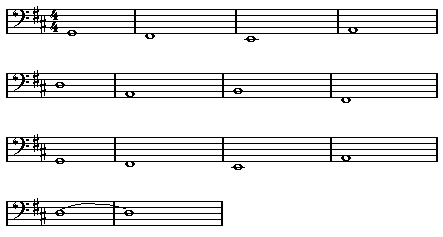

measures 5 to 8 (which are played at about the same time the vocals start, at ~0:40) are exactly the same as the first five measures of the bass part from Pachelbel's canon:


I don't know if this was intentional or just a coincidence, but it is quite a similarity.

Monday, February 17, 2020

"Telephone Line"

I was thinking about "Telephone Line" yester-day (because I'd listened to From out of Nowhere for the first time the day before, and "Telephone Line" is referenced in "Time of Our Life"), and I realized a small thing.

The last syllable of "ev'rything" in the line "I'd tell you ev'rything" is sung with a glissando (as a whole, the word is sung to the notes E F# E~C#), musically giving a sense of breadth.

Sunday, February 16, 2020

"Twilight"

This morning I was thinking about "Twilight," and I discovered a small feature in the lines "It's either real, or it's a dream / There's nothing that is in between."  It's sung to this melody:


Musically, this portrays that "nothing... in between" because it's a conjunct melody:  it goes up and down according to the steps of the scale and doesn't skip over any notes.  Disregarding accidentals, there are no notes "in between" these.

Wednesday, February 5, 2020

"Night in the City"

I was thinking about "Night in the City" this morning, and I realized that there are two features that musically emphasize the "higher" in this section:
747 just left from gate eleven
And there's no turnin' 'round
'Cause it's just leavin' the ground
And getting higher
"Higher" is sung to A notes, but then a second vocal part echoes it at a higher pitch (C notes).  Then there's an ascending bass phrase: A C E A'.

Wednesday, January 15, 2020

"The Diary of Horace Wimp"

Last night, I figured out the chords for "The Diary of Horace Wimp."  While playing along to the recording in order to make sure I had everything right, I noticed the repeated synth phrase in the coda:


This sounded somewhat familiar to me, so I did some research and discovered that it has some similarity to "First Call," an army bugle call that's also used in horse racing (it appears at the beginning of "Fugue for Tinhorns" in Guys and Dolls):


While the rhythms are different, the intervals of the synth phrase in "The Diary of Horace Wimp" match those in the first phrase of "First Call," so I think this resemblance was intentional.

Tuesday, November 12, 2019

"Sweet Talkin' Woman"

Last night I learned (at least some of) the string parts at the beginning of "Sweet Talkin' Woman."  Some of the notes in the violin part either have a trill or a lot of vibrato, and since I recorded my example using the mellotron sounds on my keyboard, I couldn't replicate that aspect.


This ends a bit abruptly, but I think that's accurate.  The original recording seems to have a hard edit between this string section and the guitar and bass.

Thursday, September 12, 2019

"Everyone's Born to Die"

When I listened to On the Third Day a couple months ago, I noticed a small feature in "Everyone's Born to Die" (included as a bonus track on the CD re-issue).  In finally getting around to writing about it to-day, I found something else in the same line.

Months ago, I noticed that "down" in the line "Well, they'll all fall down" is sung with a descending melisma (E D C), musically giving a sense of the word's meaning.  In finding the specific notes to-day so I could write about it, I also noticed that "all" is sung with a melisma (G F# E), musically giving a sense of entirety (the consonance of the repeated Ls in the line might indicate this too).

Friday, June 21, 2019

"Showdown"

At the end of the choruses in "Showdown," "night" in the phrase "the longest night" is sung with various melismas, musically giving a sense of that length.

Thursday, June 20, 2019

"New World Rising"

In the lines "Ev'rybody keep their blues away / Not for a day but evermore" in "New World Rising," the "evermore" is sung with a melisma (G F D B), musically giving a sense of duration.

Wednesday, June 19, 2019

"Oh No Not Susan"

In "Oh No Not Susan," "sighed" and "sigh" in the lines "And then she sighed" and "Look at her sigh" are both sung to a pair of notes with a slight descent (A G), giving something of a musical impression of a sigh.

Coinciding with the line "And then she laughed" in the second verse, the violins start playing tremolos, somewhat representing that laughing in a musical way.

Tuesday, June 18, 2019

"Bluebird Is Dead"

I listened to On the Third Day a couple days ago and noticed some things.

In "Bluebird Is Dead," "life" in the line "Little darlin', all my life" is sung with a melisma (B A F#), musically giving a sense of the entirety of that "all."

Saturday, May 4, 2019

"Tightrope"

Lately, I've been really into the synth part at the beginning of "Tightrope."  I recently figured out about half of the violin part in the introduction, so I had enough to make it worth recording.


I had to make some instrumental substitutions.  I don't really have access to a good synth sound (a Moog is near the top of my instrument wish list), so I used the B3 bass pedals setting on my keyboard.  The string parts are both mellotron sounds (violin and cello).  Some of the violin part is triplets, which are a bit difficult to play; I did my best.

I recorded this more from memory than anything else.  I vaguely remembered this post from a couple years ago in which I mentioned that - while they're similar - the lower string part isn't exactly the same as the synth part.  Had I lookt at that before I recorded my audio example, maybe I would have thought to reference the instrumental mix (a bonus track on the CD re-issue) for greater accuracy.  I'm pretty confident of the synth part and what I have of the violin part though.